Free shipping
| Free USA shipping on all orders over $300.
$225.00
9 in stock
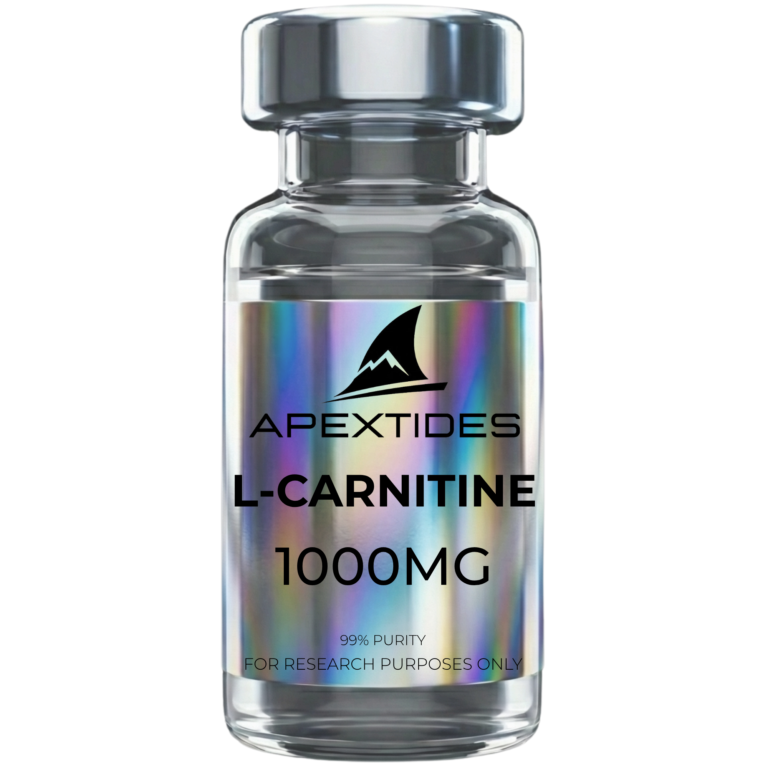
L-Carnitine is synthesized endogenously from the amino acids lysine and methionine across multiple cellular compartments, and is most concentrated in tissues that rely on fatty acids as their primary fuel source, particularly skeletal and cardiac muscle. Nature It has an obligate role in the mitochondrial oxidation of long-chain fatty acids through the action of specialized acyltransferases, and additionally serves functions in buffering the acyl-CoA/CoA ratio, branched-chain amino acid metabolism, removal of excess acyl groups, and peroxisomal fatty acid oxidation. ScienceDirect These overlapping metabolic roles make L-Carnitine one of the most extensively studied compounds in mitochondrial and metabolic research.
At the mechanistic level, long-chain fatty acids must first be esterified to L-Carnitine to form acylcarnitine before entering the mitochondrial matrix. On the outer mitochondrial membrane, carnitine palmitoyltransferase I (CPT-I) catalyzes the transfer of medium and long-chain fatty acids from coenzyme A to L-Carnitine — a rate-controlling step for β-oxidation. The acylcarnitine intermediate is then translocated across the inner mitochondrial membrane via the carnitine-acylcarnitine translocase (CACT), and CPT-II on the matrix side reconverts it to fatty acyl-CoA, which enters the β-oxidation pathway. Nature Critically, L-Carnitine also buffers long-chain acyl-CoA accumulation by converting potentially toxic acyl intermediates into exportable acylcarnitines, thereby freeing mitochondrial CoA for continued metabolic flux through the TCA cycle, pyruvate dehydrogenase, and other CoA-dependent pathways. apextides
Beyond its canonical role in fatty acid oxidation, emerging research has characterized pleiotropic functions of the carnitine pool including modulation of mitochondrial homeostasis, epigenetic regulation, inflammatory and immune signaling via NF-κB and Nrf2 pathways, AMPK-mediated energy sensing, and neuroprotection. AJKD L-Carnitine and its derivatives have also demonstrated promise in preclinical models of mitochondrial dysfunction associated with insulin resistance, obesity, vascular disease, and chronic heart failure, though further translational studies are needed to fully characterize their potential. apextides Supplied in lyophilized form for maximum stability; reconstitute with sterile bacteriostatic water prior to use in aqueous assay systems.
SKU
APEX-LCARNITINE-4
Category default
Sharing is Caring :
>>> Compound Dossier
Technical Specifications
Product Data
CAS Number
541-15-1
Molecular Wt.
161.2 g/mol
Formula
C7H15NO3
Purity (HPLC)
≥ 99%
Appearance
White lyophilized powder
Quantity
1000 MG
Description & Application
L-Carnitine (β-hydroxy-γ-trimethylammonium butyrate) is a quaternary ammonium compound synthesized endogenously from lysine and methionine, functioning as an obligate cofactor for the mitochondrial import of long-chain fatty acyl-CoA esters via the carnitine palmitoyltransferase (CPT) system. By facilitating translocation of activated fatty acids across the inner mitochondrial membrane, L-Carnitine is a key regulatory node in β-oxidation flux and is extensively utilized in research models investigating mitochondrial fatty acid metabolism, energy substrate partitioning, and lipotoxicity.
Handling & Storage Protocols
Solubility
Soluble in bacteriostatic water or appropriate solvent.
Temperature
Store refrigerated upon receipt. Long-term: -20°C.
Preparation
Reconstitute strictly under sterile lab conditions.
Integrity
Avoid repeated freeze-thaw cycles. Stable when stored correctly.
Related Products
$55.00
11 in stock
$65.00
Out of stock
$100.00
$75.00 – $150.00Price range: $75.00 through $150.00