Free shipping
| Free USA shipping on all orders over $300.
$100.00
17 in stock
How does Cagrilintide work?
Among the studied Cagrilintide peptide benefits, Cagrilintide’s mechanism of action may primarily involve its role as a long-acting amylin analog that may interact with the calcitonin receptor. The peptide may demonstrate enhanced receptor activity compared to native amylin, with potentially improved pharmacokinetic properties. Research suggests that Cagrilintide may work through multiple pathways:
The primary mechanism may involve the activation of amylin receptors in key brain regions, particularly the area postrema and other circumventricular organs. This activation may lead to enhanced signaling and altered food intake through both direct and indirect neural pathways.
Additionally, studies indicate Cagrilintide peptides may have effects on gastric emptying and glucose metabolism. Research suggests it may influence gastric emptying rate and possibly affect postprandial glucose excursions, potentially contributing to observed laboratory measurements.
The peptide’s potentially long half-life, which may be achieved through specific molecular modifications, may allow for sustained receptor activation, possibly leading to more consistent effects compared to shorter-acting analogs.
Research Applications
The following areas reflect commonly studied Cagrilintide peptide benefits within controlled research environments.
Physiological Processes: Research suggests it may influence physiological processes through possibly enhanced signaling and potentially altered intake.
Metabolic Markers: Studies indicate it may influence laboratory markers and may offer potential for research in type 2 diabetes contexts.
Extended Duration: The modified structure may provide a longer half-life compared to native amylin, potentially allowing for less frequent laboratory administration.
Gastric Function: Research suggests Cagrilintide peptides may influence physiological processes through possibly enhanced signaling and potentially altered intake.
Combination Potential: Studies suggest there may be possible synergistic effects when examined with other metabolic agents.
Observations in Studies
Clinical research suggests Cagrilintide may be generally well-tolerated, with reported Cagrilintide side effects varying across study designs.
Gastrointestinal observations during initial administration
Administration site reactions
Mild and transient nausea
Summary
Cagrilintide may represent an advancement in amylin analog research, with Cagrilintide peptides receiving increasing attention in the field of metabolic research. Its modified structure may provide enhanced pharmacokinetic properties while potentially maintaining the receptor activity of amylin. Current research suggests there may be promising applications in areas related to metabolism, with ongoing studies exploring additional research potential.
SKU
CGL10
Category default
Sharing is Caring :
>>> Compound Dossier
Technical Specifications
Product Data
CAS Number
N/A
Molecular Wt.
~4170 g/mol
Formula
N/A
Purity (HPLC)
≥ 99%
Appearance
White lyophilized powder
Quantity
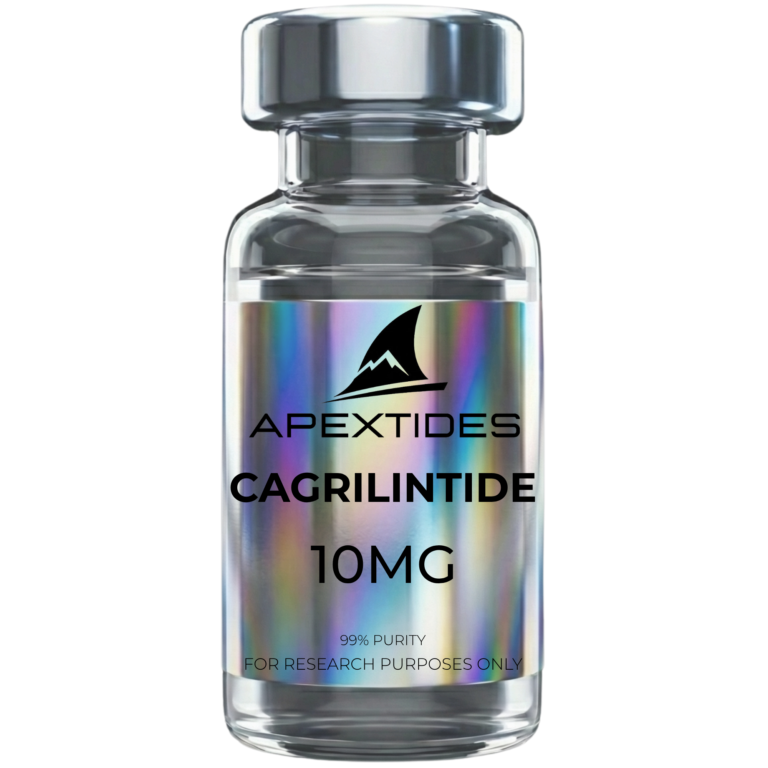
10MG
Description & Application
A long-acting synthetic amylin analog engineered for enhanced calcitonin receptor binding affinity and improved pharmacokinetic stability relative to native amylin. Its primary mechanism involves activation of amylin receptors in circumventricular brain regions including the area postrema, initiating downstream neural signaling cascades that modulate gastric emptying rate and postprandial glucose excursion in preclinical metabolic research models. Researchers investigating amylin receptor pharmacology, incretin biology, or combinatorial GLP-1/amylin signaling axes utilize Cagrilintide as a well-characterized long-duration probe.
Handling & Storage Protocols
Solubility
Soluble in bacteriostatic water or appropriate solvent.
Temperature
Store refrigerated upon receipt. Long-term: -20°C.
Preparation
Reconstitute strictly under sterile lab conditions.
Integrity
Avoid repeated freeze-thaw cycles. Stable when stored correctly.
Related Products
$70.00
30 in stock
$70.00
20 in stock
$25.00
1 in stock
$40.00
19 in stock