
Free shipping
| Free USA shipping on all orders over $300.
$30.00
Out of stock
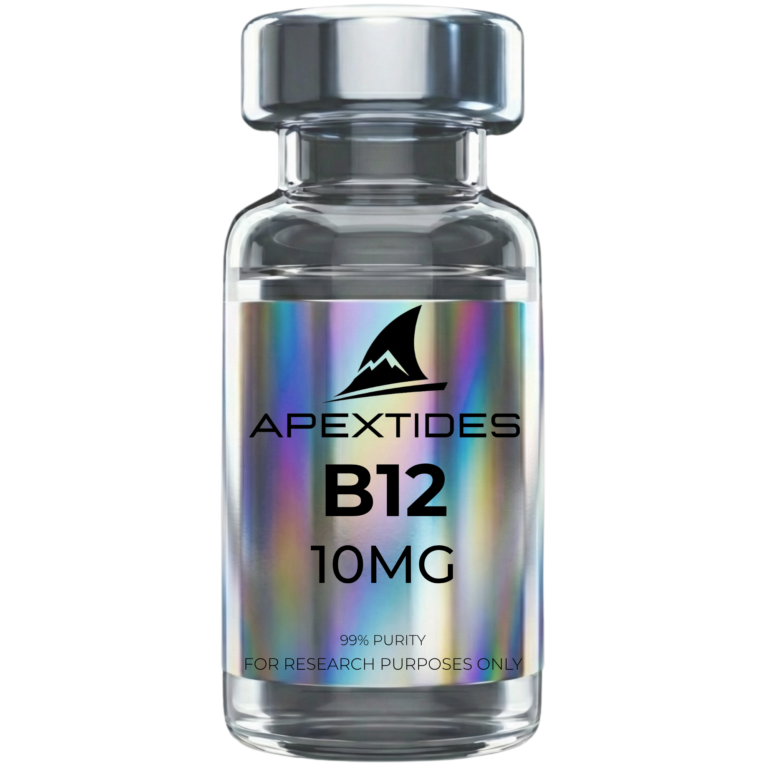
B12 (Cyanocobalamin / Methylcobalamin)
For Research Use Only — Not for Human or Animal Consumption
Vitamin B12 (cobalamin) is a water-soluble organometallic cofactor belonging to the corrinoid family, characterized by a corrin ring structure coordinated to a central cobalt ion. It exists in several biologically and biochemically distinct forms, the most studied of which are cyanocobalamin (the stable, synthetic form common in laboratory settings), methylcobalamin (MeCbl), and adenosylcobalamin (AdoCbl). Each form exhibits distinct reactivity profiles and is utilized in separate enzymatic contexts, making B12 a versatile subject of metabolic and neurological research.
At the enzymatic level, B12 functions as an essential cofactor for two primary mammalian reactions: the remethylation of homocysteine to methionine via methionine synthase (MTR), which is methylcobalamin-dependent, and the isomerization of methylmalonyl-CoA to succinyl-CoA via methylmalonyl-CoA mutase (MUT), an adenosylcobalamin-dependent reaction. These pathways are of significant interest in one-carbon metabolism research, folate cycle interactions, and mitochondrial energy substrate flux studies. Disruption of these enzymatic processes is well-documented in models of cobalamin deficiency, inborn errors of metabolism, and neurodegenerative pathology, making B12 a key variable in numerous in vitro and preclinical study designs.
In neurological research contexts, cobalamin has been investigated for its role in myelin sheath maintenance, axonal integrity, and the modulation of neuroinflammatory markers. Studies utilizing B12-deficient cell culture models have demonstrated alterations in SAM:SAH ratios, impaired methylation capacity, and upregulation of pro-inflammatory cytokines. Researchers investigating homocysteine metabolism, methyl donor availability, or mitochondrial dysfunction models may employ B12 as both a positive control compound and as an active experimental variable. Supplied in lyophilized form for stability; reconstitution with sterile bacteriostatic water is recommended prior to use in aqueous assay systems.
SKU
B12
Category default
Sharing is Caring :
>>> Compound Dossier
Technical Specifications
Product Data
CAS Number
68-19-9
Molecular Wt.
1355.37
Formula
C63H88CoN14O149
Purity (HPLC)
≥ 99%
Appearance
Red-Brown lyophilzed powder
Quantity
[Varies by Vial]
Description & Application
Vitamin B12 is a water-soluble cofactor essential to two core enzymatic pathways: homocysteine remethylation via methionine synthase and methylmalonyl-CoA isomerization via MUT, both critical nodes in one-carbon metabolism and mitochondrial energy substrate research. Cobalamin deficiency models have demonstrated measurable disruptions in methylation capacity, SAM:SAH ratios, and neuroinflammatory marker expression, making B12 a widely utilized variable in metabolic, neurological, and mitochondrial dysfunction study designs.
Handling & Storage Protocols
Solubility
Soluble in bacteriostatic water or appropriate solvent.
Temperature
Store refrigerated upon receipt. Long-term: -20°C.
Preparation
Reconstitute strictly under sterile lab conditions.
Integrity
Avoid repeated freeze-thaw cycles. Stable when stored correctly.
Related Products
$70.00
30 in stock
$70.00
20 in stock
$25.00
1 in stock
$40.00
19 in stock