
Free shipping
| Free USA shipping on all orders over $300.
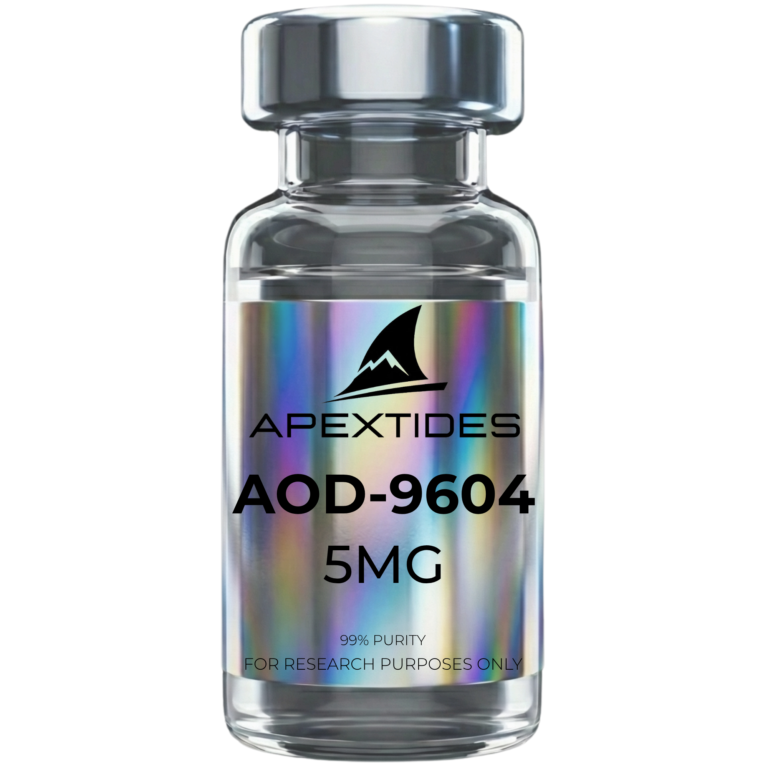
$65.00
Out of stock
Overview
AOD 9604 is a peptide that was developed in the 1990s as part of efforts to create compounds that might exhibit anti-obesity properties similar to human growth hormone (hGH). Since then, extensive scientific studies have been conducted to explore its potential role in lipolysis.(1) Lipolysis refers to the process by which stored fats, or triglycerides, within fat cells are broken down into glycerol and free fatty acids, which may then be utilized by other cells as an energy source. Enzymes such as lipase are believed to play a key role in facilitating this breakdown.
It has been proposed that AOD 9604 may influence fat cells and lipolytic receptors, particularly based on observed associations with changes in body weight and fat composition in murine models. Findings from research studies suggest that this peptide fragment may enhance lipolytic sensitivity following administration. Additionally, investigators have hypothesized that AOD 9604 may interact with the beta-adrenergic pathway, specifically the beta(3)-adrenergic receptors (beta(3)-AR), which are considered primary lipolytic receptors in adipose tissue.
Although the exact mechanism remains unclear, studies have observed an increase in the expression of beta(3)-AR RNA in the presence of AOD 9604. This observation may indicate that the peptide could contribute to increased sensitivity of these receptors, potentially making fat cells more responsive to lipolytic signals. However, it is important to note that while AOD 9604 appears to elevate beta(3)-AR expression, it may not act directly on these receptors to produce its potential lipolytic effects.
Researchers have also suggested that the modified segment of hGH represented in AOD 9604 may be responsible for promoting fat metabolism, potentially without stimulating the production of insulin-like growth factor 1 (IGF-1), which is typically associated with natural growth hormone activity.
Research and Clinical Studies
AOD 9604 Peptide and Lipolytic Activity
Early studies were carried out on obese mice where the AOD 9604 peptide was periodically introduced for 14 days. Following the experiment, the results reported a reduction in weight and excess fat. These results appeared directly correlated with the increased levels of major lipolytic receptors, beta(3)-AR, found in the fat cells. AOD 9604 peptide appeared to exhibit action similar to hGH wherein both may be capable of increasing repressed levels of lipolytic receptors in obese mice as compared to the lean mice. To confirm whether the lipolytic action of AOD 9604 might merely be associated with the increased lipolytic receptor levels, additional studies were carried out where AOD 9604 was given to mice with knocked out lipolytic receptors. Further analysis suggested that the AOD 9604 peptide enacted the lipolytic action via increased energy expenditure and fat oxidation.(1) Both these findings on chronic and acute action of AOD 9604 suggested that while enhanced beta(3)-AR expression may have played a role in the chronic action of the compound, beta(3)-AR might not be the sole arbiter in this reaction. Oxidation and enhanced energy expenditure appeared to be vital in the proposed action of the peptide.
In 2000, a research study was carried out in obese Zucker rats where the AOD 9604 peptide was given daily for 19 consecutive days. Following the study, it was reported that weight appeared to be reduced in all rats by over 50%, in comparison to the rats given a placebo. Further analysis suggested that the adipose tissues of the AOD 9604 peptide animals had increased lipolytic activity and no marked insulin sensitivity interruption in the animals.(3)
AOD 9604 Peptide and Obesity
In 2004, clinical trials observed the actions of the peptide in 300 obese subjects who were given the peptide for 12 weeks. The rate of weight loss remained consistent throughout the study period. The trial results noted minor improvement exhibited in the subjects’ cholesterol profiles and glucose tolerance levels.(4)
AOD 9604 Peptide and Cell Regeneration
Additional research was conducted to study the regenerative potential of the peptide. In 2015, 32 white rabbits were divided into four groups of eight, and each group was given a placebo, AOD 9604, hyaluronic acid, or a combination of AOD 9604 and hyaluronic acid for 4 to 7 weeks. After the study, these rabbits were assessed morphologically and histopathologically to determine the degree of cartilage degeneration. It was concluded that rabbits given the combination of AOD 9604 with hyaluronic acid apparently exhibited the least degeneration. Thus, it was suggested by the researchers that AOD 9604 might exhibit potential to enhance cartilage regeneration and cartilage repair in some capacity.(5)
This may be due to the potential role of AOD 9604 in cellular differentiation processes and, potentially, in the synthesis of proteins important for tissue repair. According to an in vitro study, AOD 9604 may possibly enhance the differentiation of adipose mesenchymal stem cells into bone(5). These stem cells, which are typically found within fat tissue, may have the potential to evolve into various cell types. It has been hypothesized that under the influence of AOD 9604, these stem cells may show a predisposition to differentiate into bone cells. Moreover, when the research was conducted on isolated bovine chondrocytes, it appeared that there might be an increased production of proteoglycan and collagen. Chondrocytes are cells believed to be found within cartilage tissue, and they possibly play a role in producing and maintaining the extracellular matrix, which consists of components like collagen and proteoglycans. It is posited that the presence of AOD 9604 could stimulate these chondrocytes to produce more of these vital components. The study also hints at the idea that AOD 9604 might promote the differentiation of myoblasts into C2C12 cells. Myoblasts are thought to be precursor muscle cells, and C2C12 cells are a type of murine model muscle cell line. From what the study suggests, AOD 9604 may assist in the transition of these precursor cells into a more mature form. The research seems to underline the potential role AOD 9604 might have in processes connected to the repair of bone, cartilage, and muscle tissues.
AOD 9604 and Research in Cancer Cells
The peptide may be able to bind (target) tumor-related proteins to enhance tumor drug accumulation and local cytotoxicity.(6) The hGH fragment AOD 9604 may potentially play a pivotal role in cancer cell research, as it has been observed to enhance the anticancer efficacy of doxorubicin, a commonly recognized chemotherapeutic agent. One study utilized chitosan nanoparticles, a biocompatible and biodegradable polymer, as a carrier for doxorubicin and AOD 9604.(6) The research team hypothesized that AOD 9604 possibly enhanced the doxorubicin binding to multiple breast cancer cell protein targets, thereby exhibiting greater anti-proliferative activity against the MCF-7 breast cancer cell line compared to chitosan loaded with doxorubicin alone. This suggests that AOD 9604 may potentially augment the anti-cancer potency of doxorubicin while possibly minimizing unintended actions associated with non-target tissue exposure. In conclusion, multiple clinical studies have suggested that the peptide may significantly induce lipolysis and possibly prevent lipogenesis by mimicking natural hGH.
AOD 9604 is available for research and laboratory purposes only. Please review and adhere to our Terms and Conditions before ordering.
References:
Mark Heffernan, Roger J. Summers, Anne Thorburn, Esra Ogru, Robert Gianello, Woei-Jia Jiang, Frank M. Ng, The Effects of Human GH and Its Lipolytic Fragment (AOD 9604) on Lipid Metabolism Following Chronic Treatment in Obese Mice and β 3-AR Knock-Out Mice, Endocrinology, Volume 142, Issue 12, 1 December 2001, Pages 5182–5189. https://pubmed.ncbi.nlm.nih.gov/11713213/
Moré, M. I., & Kenley, D. (2014). Safety and metabolism of AOD9604, a novel nutraceutical ingredient for improved metabolic health. Journal of Endocrinology and Metabolism, 4(3), 64-77.
Frank M. Ng, J Sun et.al, Metabolic Studies of a Synthetic Lipolytic Domain (AOD 9604) of Human Growth Hormone, Hormone Research, February 2000.
News, Medical and Life Sciences, Obesity drug codenamed AOD 9604 highly successful in trials, 16 December 2004.
Dong Rak Kwon and GI Young Park, Effect of Intra-articular Injection of AOD9604 with or without Hyaluronic Acid in Rabbit Osteoarthritis Model, Annals of Clinical and Laboratory Science, Volume 45, July-August 2015.
Habibullah, M. M., Mohan, S., Syed, N. K., Makeen, H. A., Jamal, Q. M. S., Alothaid, H., Bantun, F., Alhazmi, A., Hakamy, A., Kaabi, Y. A., Samlan, G., Lohani, M., Thangavel, N., & Al-Kasim, M. A. (2022). Human Growth Hormone Fragment 176-191 Peptide Enhances the Toxicity of Doxorubicin-Loaded Chitosan Nanoparticles Against MCF-7 Breast Cancer Cells. Drug design, development and therapy, 16, 1963–1974. https://doi.org/10.2147/DDDT.S367586
SKU
APEX-AOD9604-26
Category default
Sharing is Caring :
>>> Compound Dossier
Technical Specifications
Product Data
CAS Number
221231-10-3
Molecular Wt.
1815.1 g/mol
Formula
C78H123N23O23S2
Purity (HPLC)
≥ 99%
Appearance
White lyophilized powder
Quantity
5 MG
Description & Application
AOD-9604 (hGH Fragment 176-191) is a synthetic C-terminal peptide fragment of human growth hormone, specifically corresponding to amino acids 176–191 of the native hGH sequence, engineered to isolate the lipolytic domain of hGH activity while dissociating it from IGF-1 stimulation associated with full-length growth hormone. Research in murine adiposity models has investigated its proposed mechanism involving upregulation of beta(3)-adrenergic receptor (β3-AR) RNA expression in adipose tissue and enhancement of energy expenditure via fatty acid oxidation pathways, independent of direct β3-AR agonism. AOD-9604 has additionally been studied in cartilage regeneration models and as a potential drug delivery adjuvant in oncology research contexts.
Handling & Storage Protocols
Solubility
Soluble in bacteriostatic water or appropriate solvent.
Temperature
Store refrigerated upon receipt. Long-term: -20°C.
Preparation
Reconstitute strictly under sterile lab conditions.
Integrity
Avoid repeated freeze-thaw cycles. Stable when stored correctly.
Related Products
$55.00
11 in stock
$65.00
Out of stock
$100.00
$75.00 – $150.00Price range: $75.00 through $150.00